Last weekend I attended Foolscap, a small, local Fantasy and Science Fiction convention. One of several cool things about Foolscap is the Friday Writer’s Workshop. I got to attend four presentations, all of them extremely useful and informative.
The Villains workshop was particularly eye-opening for me. It was taught by the amazing Kat Richardson, author of The Greywalker Novels. She recently wrote an essay, “A Wretched Hive of Scum and Villainy” about how important a Villain is to a story. Kat is not only a gifted writer, but also an excellent teacher.I had several actual “ah-ha” moments during Kat’s workshop. In particular, I have two short stories I’ve been working on that were sort of “stalled” because I knew something was wrong, but I didn’t know what. Now I know – they need a “better” villain! The villain defines the conflict. If the story is kind of ho-hum and uninteresting, it’s probably because the conflict is too vague or undefined. What does it need? A villain. A villain that’s as deep and fleshed-out as the hero.
I shouldn’t have been surprised. A couple weeks ago I was in the process of creating my new character for a GURPS-based role playing game. My husband and I joined a group that is just starting a new campaign. So I was paging through the “GURPS Basic Set: Characters” book, reading about possible Advantages and Skills for my character. I mostly skimmed through the positive traits I could “buy” with points. The Disadvantages (faults) and their consequences were far more interesting. (I chose “Weirdness Magnet”, -15 points.)
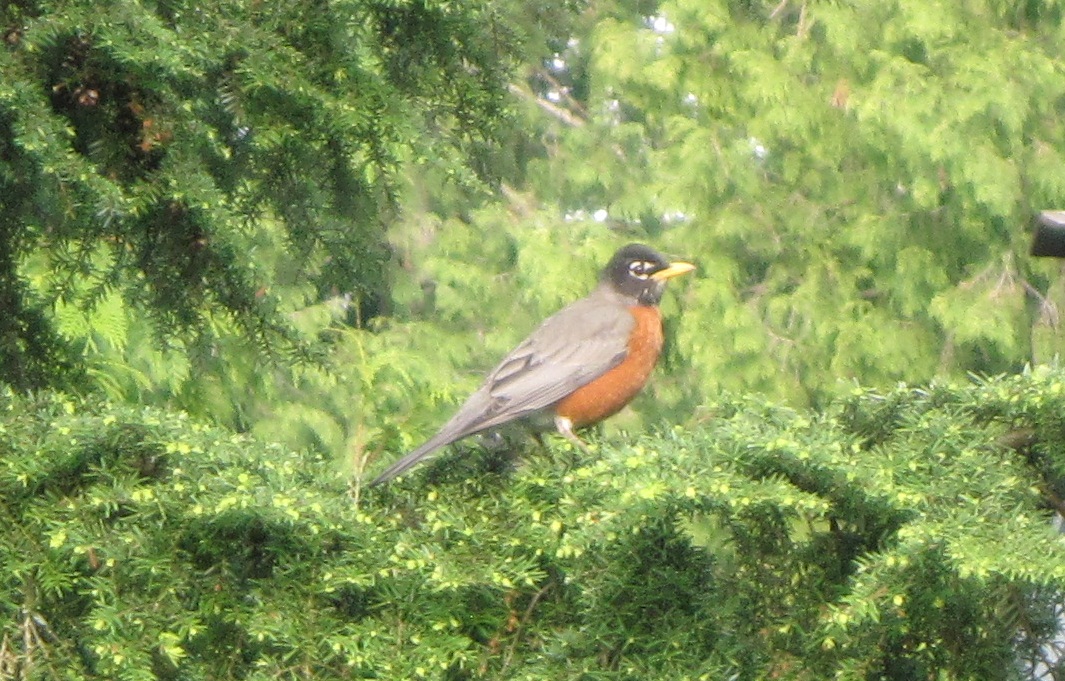
A robin and his breakfast.
Speaking of villainy, I am now a First Reader at Strange Horizons! I am very excited about this opportunity. It’ll take a lot of time and work, but I feel so honored to get this awesome learning experience!
No, I will not be blogging about reading from the “slush pile”. For anyone that is interested in an “inside perspective” from the point of view of experienced First Readers, I recommend Sarah Olson’s blog post (from a few months back) “Slush Readers’ Advice for Writers”.
I recently wrote a guest blog post for Penumbra eMagazine. When I received that email from the blog manager asking if I was interested in writing a guest blog, I felt really pleased and flattered they asked me. That was my first reaction. My second reaction was panic. What would I write about?
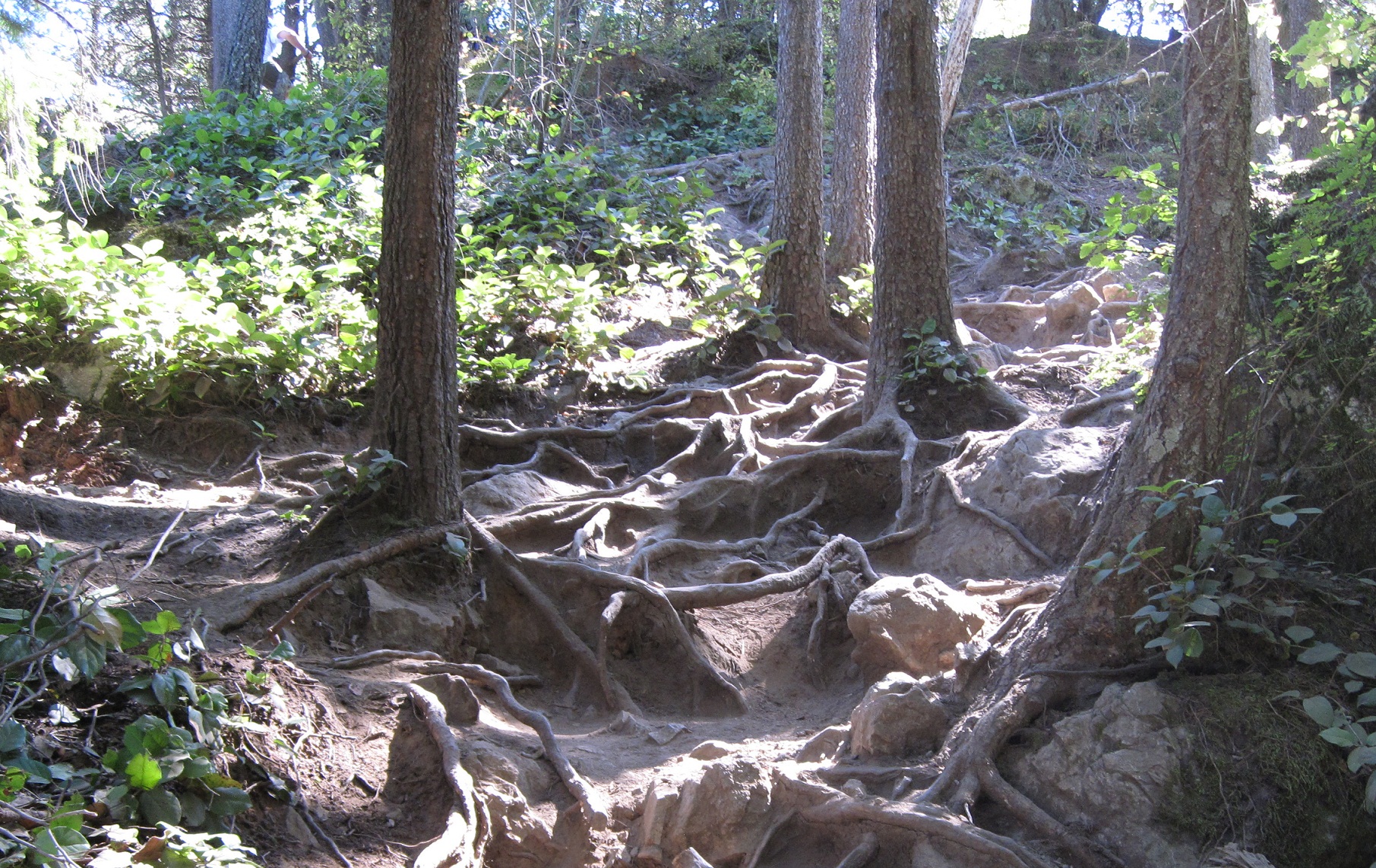
We went for a family hike up Little Si, North Bend WA, on August 25. View of an interesting part of the trail, with criss-crossing tree roots.
I often think there is a certain arrogance or audacity to keeping a blog about becoming an author, especially since I am not in any way an expert on (well anything really, but especially) writing. There are many other blogs on the internet written by widely published authors who can give far better advice than me. (Links to some of my favorites appear in the “Resources for Writers” table on the right.) When I blog I try to stick to my own experience and the perspective of a writer just starting out and trying to get published.
So for my guest blog, I wrote about something that was going on in my life (sorting through my family’s collection of children’s books) and related that to writing speculative fiction.
But first, I read all of the entries on the Penumbra blog for the last three months to get an idea of what other blog posts looked like. (That actually increased my anxiety, because the site has interesting posts written by some very noteworthy people.) I also did some internet research, searching on “guest blogger etiquette”, to make sure I didn’t do anything really stupid or embarrassing. Then I wrote the post. Lastly, I submitted my guest blog post early (just-in-case it needed editing or revision:-)
If you read that guest blog post on Penumbra, you may be wondering which picture books among the collection were my favorites. I have many, but here are a few:
So now I’ve written a blog post about blogging. (Hopefully that’s not as lame as it sounds.) What are your favorite children’s books, and how have they influenced your writing?
This week the twins and I have been visiting my mother in my home town, and tonight I will be participating in a time-honored American tradition. I’ll be attending my high school reunion.
My (fraternal) twins
In terms of writing, it’s been a productive week. I did some major editing on one short story, and made progress on the first draft of another. I also wrote a guest blog post, and once it goes online I’ll link to it here.
For my own blog I added a Twitter feed, Blogroll, and “Resources for Writers” table. (I am embarrassed to admit how long it took me to figure out how to use the WordPress Links Widget. So I won’t.)
There is something surreal about a high school reunion. In many ways it’s difficult to figure out why I want to attend. High school was one of the low points of my life. I was painfully shy, had few close friends, and low self-esteem. I didn’t attend my senior prom, mainly because no one asked me. Academically, I was/am smart, but I only did well in the subjects that interested me. In retrospect I was a downright average, angsty and self-centered teen. So after thirty-five years, why on earth would I want to relive any of that?
For me, the reunion’s biggest draw is the potential to reconnect face-to-face with people I truly regret losing touch with.
Unlike in films or in some books, one moment in time does not define who someone is now. People evolve. Anyone who really wants to can redefine themselves as many times as they need to during their lifetime. I’m looking forward to getting to know some of my ex-classmates again, to finding out where they are now, and to appreciating how they’ve grown.
One thing I’ve learned from writing is that every life experience has the potential to become story fodder. As a speculative fiction story setting, a high school reunion is practically cliché. (BTW, if a time-traveling version of myself wants to carpool in a DeLorean, come on by. Just sayin’.)
No doubt I will be uncomfortably reminded of the person I was when I was eighteen. She had a few more flaws I’m not going to advertise here. The odd thing is, I still feel like the same person, even though I’ve changed. I wouldn’t be surprised if she shows up as a character in one of my stories. So there’s one advantage to being reminded of her. Tonight I’ll get to observe how time has affected a few dozen other people. Some of them may appear in a story or two down the road.
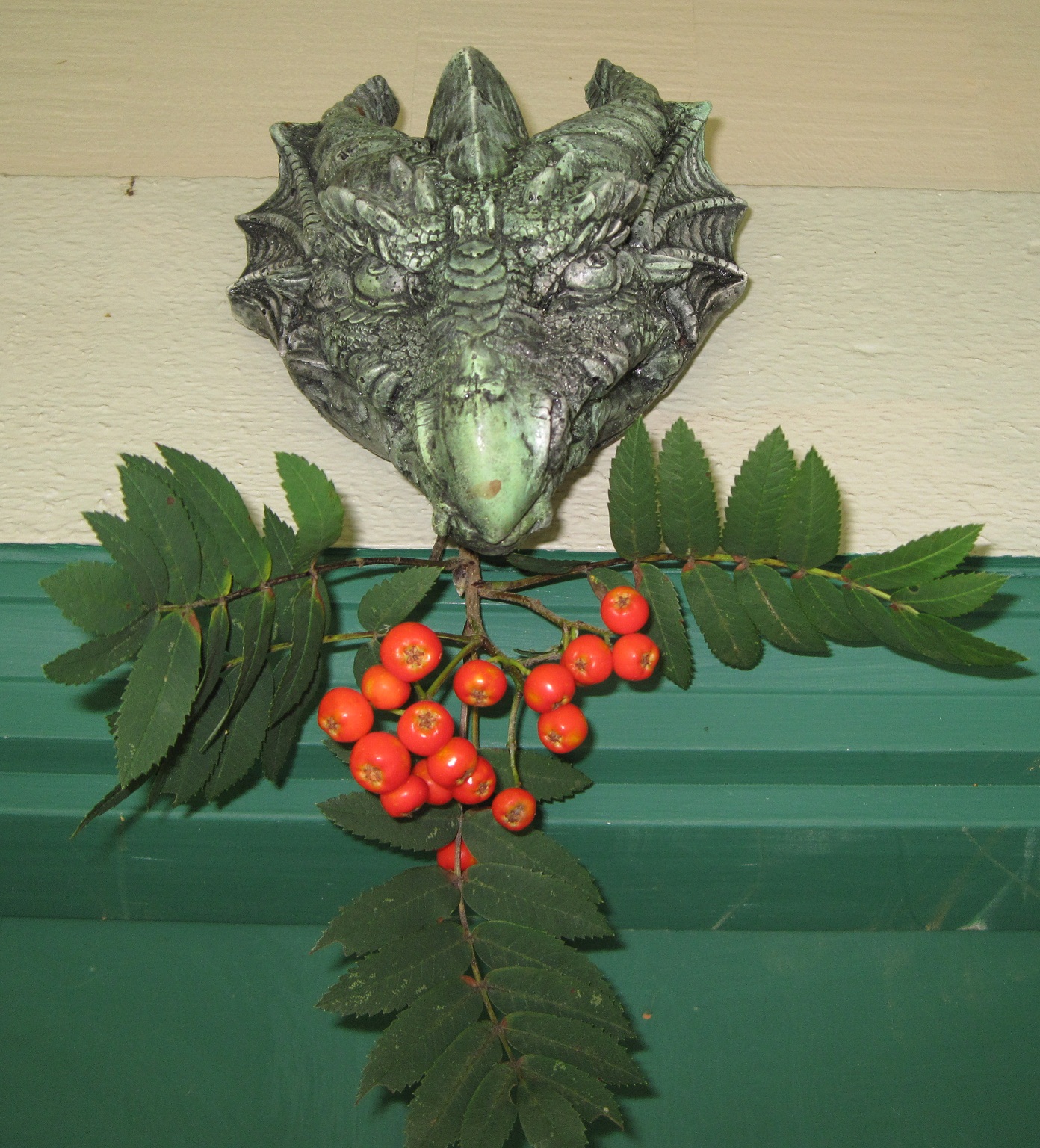
The Dragon guarding our front door, with Rowan berries.
It’s Lùnastal, also known as Lughnasadh and several other names including the first of August. Lùnastal is among other things a harvest festival; a time to celebrate the first fruits of summer and to anticipate the bounty of the harvest season. This seems a good time to reflect on the things I have accomplished, or not accomplished, so far this summer.
Confession time. Summer is more than half over, and since my kids said goodbye to elementary school in June, I have not finished a single story. I foolishly (or responsibly – my POV changes) scheduled summer activities that meet my children’s needs instead of my own. After all, being a parent is my day job and writing is my hobby.
Our summer started with the biennial Slighe nan Gaidheal 2012 Seattle Fèis. I reprised my 2010 committee role as registration manager on top of my newish role as SligheTreasurer. It was a truly wonderful experience and because of the hard work and dedication of many people, especially event chairs Seumas Gagne and Kate Freeburg, a tremendous success. But until recently I was utterly burnt out.
What have I been doing to improve my writing, when I can’t get more than ten or fifteen minutes in a row of quiet writing time? I have been reading. Pretty much any writing instructor or author will tell you that reading in the genre you’re writing is essential, and I have definitely found that to be true. Before I started trying to write short stories, I hadn’t actually read many short stories. (Charles de Lint’s short stories are the exception; I’ve been reading both his novel-length and short fiction for a long time.) So I’ve been reading short stories from online speculative fiction eMags. I just finished a collection of Connie Willis’ short fiction, and yesterday I bought a Steampunk anthology edited by Sean Wallace.
I could also claim to have writer’s block, except that would be a lie. What I have is more like writer’s ADHD. I start reworking a story that’s been languishing in the first-draft stage, and then I get distracted by a new idea. I take a break to write down the idea (either for a new story or some aspect of an in-progress story) and tell myself I just need to make sure I don’t forget it. The next thing I know, I’m writing that new/other story. Until the next distraction!
Speaking of writing distractions, I will add world building to my list. I have been developing ideas I have for a novel that will take place on another planet. Creating that world is both daunting and exciting; and of course fun! The dominant sentient species there is human. How did they get there? What happened to the original alien inhabitants? What are the origins of the two main religions, and how have they deviated from their founder’s intentions? How have the cultures and religions been affected by the environment? It’s a bit like playing god (or goddess in my case;-)
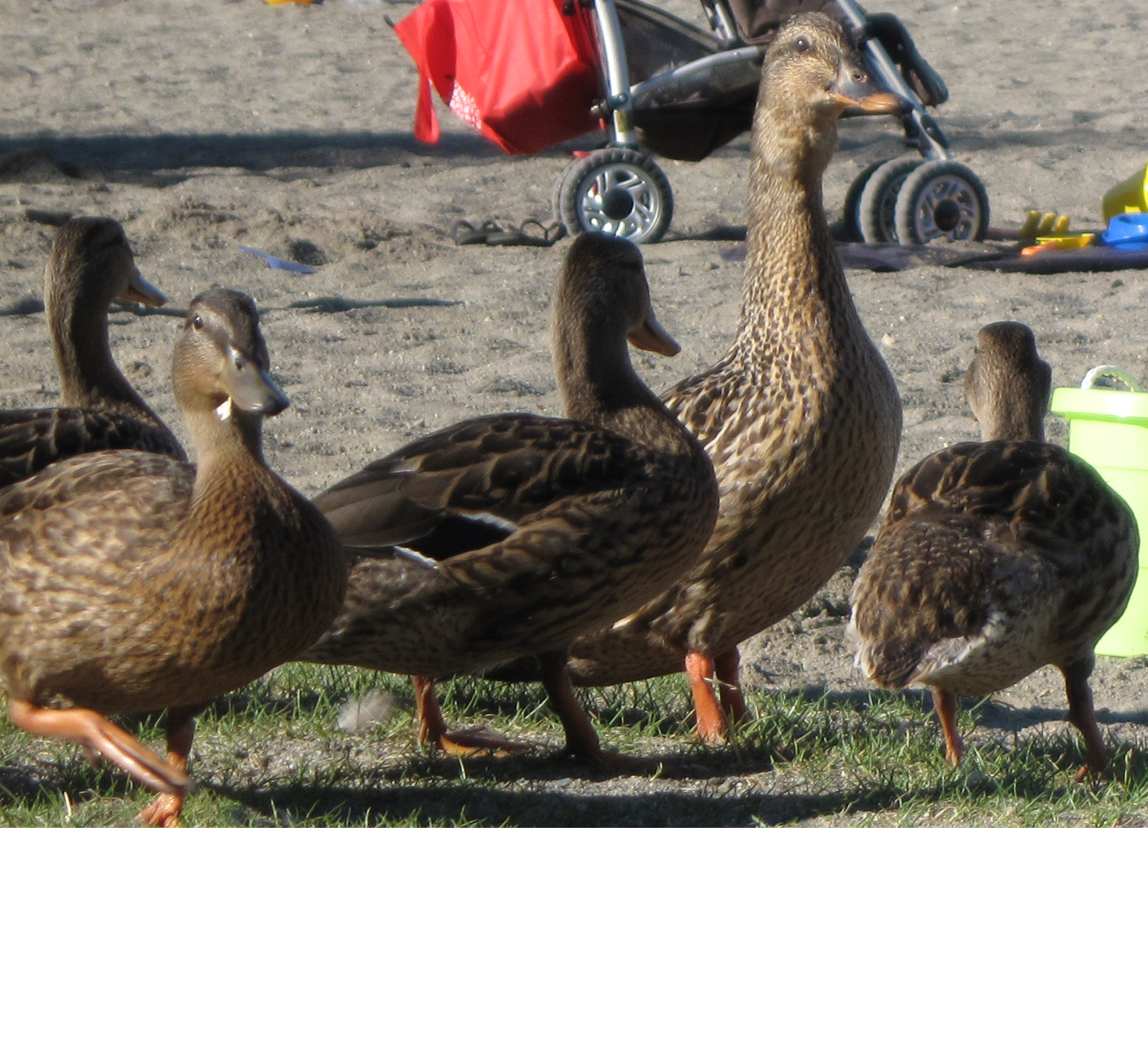
This photo has nothing at all to do with my blog post! I took the kids to Idylwood Park last week, and this family of ducks were going around stealing food. The crowds of people didn’t bother them at all.
Yesterday I got an email from the Editor in Chief of Penumbra eMag.
My “Dream Catcher” story will be in the September Native American folklore issue!!!
I must admit that I was sort of expecting to hear from Penumbra. I had been watching acceptance and rejection reports on Duotrope, so I knew the decisions would be made around mid-July about what stories would be used for the September issue. At the end of April I got a “passed on to the next level” email, and in mid-June I got a “final round of consideration” email. So I was looking forward to a personal rejection, and I already had the next market-for-submission picked out.
When that email arrived in my inbox yesterday, I had to read through it a couple of times before it sunk in that I really did get an acceptance. I found my husband watching TV and told him. I went back to my computer to read the email again to make sure it was still there. I phoned my mother. I emailed my sister and a close friend. After about an hour, I still hadn’t gotten another email telling me it was all a mistake, so I posted an announcement on my facebook page.
I also agonized for about twenty minutes over whether or not it was appropriate to reply to the email acceptance with a thank you. In my speculative fiction critique group, we have discussed responding to a rejection several times. (Btw, the conventional wisdom I have gathered is that you do not respond to a rejection. Editors are usually far too busy to deal with even a “thank you for your consideration” email. Some emag website submission guidelines even ask writers not to.) But, no one ever talked about how to respond to an acceptance! In the end, I went with my gut feeling and I did send a thank you email, to which the EIC responded graciously.
So now I guess I’ll be working on getting that second story published;-)
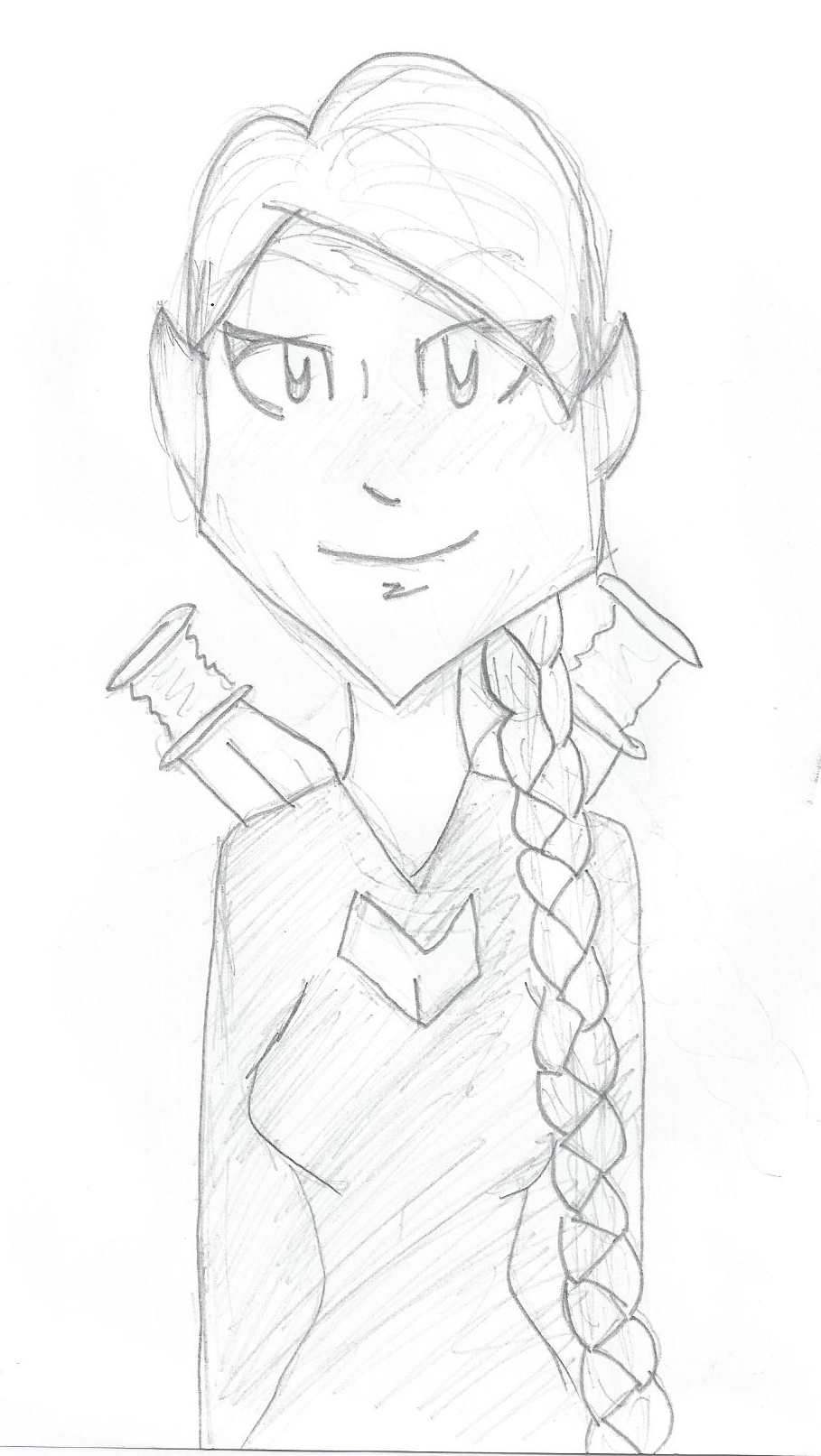
One of my DA:L characters, as imagined and drawn by my daughter Aly
This blog is supposed to be about my learning experiences on the “path” to becoming an author. But it’s time for me to diverge and talk about another writing activity I indulge in. It’s a play-by-email role-playing-game (PBEM RPG).
The usual response, when I explain this activity to people I know or meet, is a blank look. Most people have heard of role playing games like Dungeons and Dragons and yes, it’s a bit like that. The “game” is played by writing pieces of the story, and posting it via email to the other players. So unlike D & D, we don’t play it in real time, it’s more like writing a story cooperatively. I write all of the actions and dialogue for my own character(s), and the other players do the same for their characters. Chances are, if you aren’t a writer, or rpg-gamer, your eyes have glazed over by this part of my explanation.
We write in a shared world. The story is set in the world of Dragon Age, a video game, so technically this cooperative story is fanfiction. The name of the RPG is Dragon Age: Legacy (DA:L). From my point of view, PBEM RPG exists in a void between original writing and fanfiction, between a face-to-face RPG and a written story, between programmed characters in a video game and real people.
I thought I would delve a little more into what it is about this writing activity I like so much. I figure that my family, at least, might like to know.
First, I love the writing. To me it’s the best, most fun part of writing. Writing just for fun, writing to set the story down, writing to move the story along, writing to share the experience with a relatively small audience of other writers who are also invested in the story. Each post doesn’t need to have perfect grammar, it doesn’t have to be publish-worthy, it’s just fun.
Before I go on, let me just clarify something. Overall, the writing in our shared DA:L story may not be polished enough to be published as-is, but I think we have some damn good story telling going on.
The characters (all original) form friendships, experience adventures, and indulge in romance, conflict, etc. Writing a PBEM RPG is different than writing a story, because although I can influence the plot, I have no control over what the other characters do. That might drive some writers crazy, but I enjoy that part. As I have gotten to know the other writers, and as they have developed their characters, I am better at predicting what they might do, but I never know for sure.
Quite a few writers look disparagingly upon fanfiction. I totally understand why some people feel that way. I personally think fanfiction is a wonderful way to get started writing. It’s what got me started. But I will stop there in my defense of fanfiction because plenty of other people have covered that already.
For our RPG, using a world that is already extremely well-defined (it has a wiki and everything) just makes everything so much easier, like a D & D dungeon already mapped out. Each of the writers has played throughthe Dragon Age video game(s). The world is already built; the playground is just there for the characters to explore and enjoy, ready for the writers to create adventures there, with little effort needed from the Game Master (GM) to maintain it. Many of our players (including myself) were recruited from the Dragon Age fanfiction community.
One of the ways DA:L differs significantly from a fanfiction story, is that ALL of our player characters are original. Sure, the “cannon” characters exist in the world, but on the rare occasions when one of our player characters needs to interact with a cannon character, the GM makes sure he or she behaves in a way consistent with “cannon”. So we don’t make major changes to this world that doesn’t belong to us, we are only borrowing it after all.
One of the most important habits of writing is, as I said in my first blog post, to just keep writing. DA:L keeps me writing.
In the interest of full disclosure, there IS a down side to all this writing fun. Sometimes another player will respond the same day to a post their character is tagged in. But more often it takes several days, and occasionally as long as a month. That used to bug me. But I’m over that. Honestly, when another player goes quiet for a couple of weeks, what goes through my mind isn’t annoyance they haven’t posted, but worry that they’ve decided to quit the game. Because I personally hope to keep writing it for a very long time!
The story existed in a world created and owned by a software gaming company. Although certain locations in the world were well defined visually – as the backdrop for the popular video game – most of the world was a blank canvas. The road their characters traveled was black and white, a two-dimensional line between points on a map. The group of writers used the magic of words conveyed by email posts to give it form and substance, color and emotion, aroma and taste. The world came equipped with a history and lore, predetermined races, iron-age technology, and rules for using magic. The writers came equipped with imagination, dedication, and a passion for storytelling. The writers adopted that world and nurtured it, until it blossomed and grew into something new and unique. They brought their world to life.
Tentacles and Bagpipes (sounds like the name of a pub)
In every writing class I’ve taken so far, right after the subject of editing is covered, someone always asks: how much editing is too much? How do you know when you’re finished editing and the piece is ready to submit? Usually a fascinating discussion ensues, because everyone has their own opinion. But I never felt like I left with a satisfying answer. Under-editing is usually my problem. I know there are perfectionists out there. I am not one of them.
I suspect the real answer is something like this: when you know what you’re doing, you’ll know when the story is ready to submit.
I still don’t know what I’m doing, but I submitted a short story to a speculative fiction market today anyway.
Since I’m still trying to learn, I brought this story to the point where I think it’s ready through a long process of trial and error. The title has changed a couple times, but if you are one of the people I begged to critique it, you will recognize it as the “Alien and Bagpipes” story. The current title is “Earth Music” (about 1100 words).
It started as a writing prompt from one of Cat Rambo’s classes, something like: “Describe an earth object from the point of view of an alien.” So obviously I chose to describe Highland bagpipes from the point of view of an octopus-like alien that lives underwater.
But, a description isn’t a story. So I added background to explain why the alien had the bagpipes, and what he was planning to do with them. I thought the story was finished, and I submitted it too soon. Re-reading that “story” now, it is clear to me that not only did it need more editing, but it wasn’t complete.
So after it was rejected the first time I added a conflict. I added an unhappy ending. I edited. I took out the extra adjectives and adverbs and did my best to make sure any remaining adverbs were pulling their own weight. I submitted to another market. By the time it was rejected, I had joined a critique group, who were kind enough to work-shop it. I got great feedback, and one writer suggested that I take the circumstances that led to the unhappy ending and “really go for it”.
The story sat on the back burner for a couple months before I came back to it. I re-wrote it so that the entire story builds up to the ending. I asked for critiques and was lucky enough to get some extremely helpful input from a total of six people.
This afternoon I convinced myself it was ready to submit. Again. If I had tentacles I’d be crossing them now.
# # #
P.S. I sincerely hope that no one who reads my “Earth Music” story is offended by what happens to the bagpipes in the end. Cha d’rinn cròn air pìob sam bith ri sgrìobhadh na sgeulachd seo. (No bagpipes were harmed in the writing of this story.)
One added comment:Except for the photo of me on the “About” page, so far all of the photos on this blog were taken by me. For this particular post I tried to find an image of tentacles and bagpipes on the internet. I was shocked to discover there weren’t any. I had to resort to making my own. What’s up with that? Really, interwebs, you let me down this time!
View on the Isle of Skye, taken on our July 2011 holiday
As mentioned on my “About” page, I’m a Gàidhlig learner. Sadly, I’m not very good at it, so far. The partner of one of my teachers suggested that I try writing in Gàidhlig. If only! I can barely write the simplest of sentences, so far.
The Seattle Fèis is coming up very quickly. Four whole days of Scottish language and culture with tradition bearers in the areas of language, song, pipes, harp, and fiddle, including native Gàidhlig speakers from Scotland and Cape Breton! I am SO looking forward to it.
What does learning Gàidhlig have to do with improving my writing (in English)?
An interesting side effect of learning (or in my case attempting to learn) Gàidhlig, is that it has made me look at the English language a little differently. Not only do I think about grammar in a more analytical way (verb, noun, adverb, adjective, preposition, dependent and independent clauses, dative case, and genitive case) but I am more aware of the way language influences the way I perceive the world.
In English the “basic” sentence structure is Subject – Verb – Object. To form a question, the order is changed to Verb – Subject – Object.
Gaelic languages (Irish, Welsh, Gàidhlig) are verb-centric. In most sentences the verb comes first, Verb – Subject – Object. Every verb has different forms that indicate tense, and whether it is positive or negative, statement or question. (Sentences using question words – who, what, how, how many, why, where – are handled a little differently). There is no word for “yes” or “no”, you answer a question with a negative or positive form of the verb used in the question.
For example, for this question:
A bheil thu sgìth? (Are you tired?)
The positive answer can be: “Tha” (yes) or “Tha mi sgìth” (I am tired).
The negative answer can be: “Chan eil” (no) or “Chan eil mi sgìth” (I am not tired).
Another example:
An do sgrìobh thu an-diugh? (Did you write today?)
Positive answer: “Sgrìobh” (yes) or “Sgriobh mi an-diugh” (I wrote today).
Negative answer: “Cha do sgrìobh” (didn’t write) or “Cha do sgrìobh mi an-diugh” (I didn’t write today).
As a writer, I wonder if thinking in English influences me to care more about who or what is doing something, rather than what they’re doing. Is that why I have to make a conscious effort to avoid lazy adverbs and come up with good verbs in my attempts at writing?
If I ever get to the point in my learning where I can think in Gaelic, maybe I’ll see the world a little differently. At the Seattle Fèis, I’m looking forward to asking the native Gàidhlig speakers how they think.
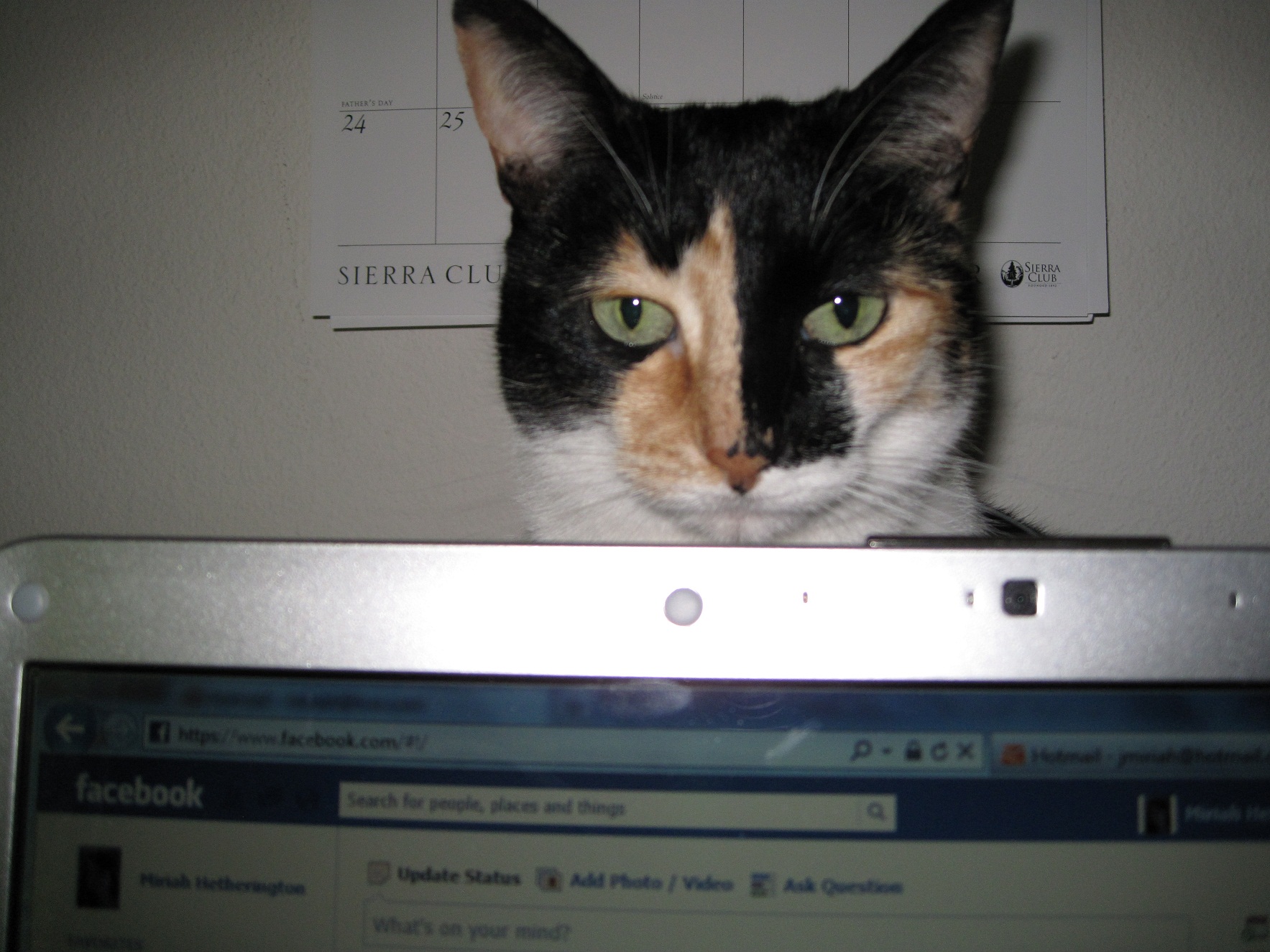
Kiki demonstrates the lazy nature of the verb “was”
What words of wisdom do I have regarding self-editing? To start with, I recommend a book by Ken Rand, The 10% Solution. The sticker price is $10, and it’s a slim book and a quick read. Like all how-to-write books, I expect more of it will be meaningful to me as my writing improves, but for now it has two main ideas I frequently use now.
1) Read the story aloud. This advice is just so important. Many errors, awkward sentences, overused words, and bad grammar just jump right out at you when you read the story aloud.
2) Use the search function on your word processor to identify problem markers. In his book Ken Rand identifies twenty-six words and suffixes to scrutinize. This is a very useful tool for zeroing in on problem areas of a story that may need rewriting.
I could just end there with the advice to go read that book. (I really do recommend it.) But first I’d like to explain my own take on why “ly”, “ing”, “was”, and “of” (as examples) are problem indicators. I don’t love to study grammar, but lately I’ve found that knowing a little bit about grammar helps me understand why certain word constructions are more successful than others.
Most adverbs end in “ly”. The purpose of adverbs is to modify the verb. Now, verbs are what bring life to a story. Good verbs engage the reader and drive the action. But adverbs are word vampires. They suck the life energy right out of a verb, and slow it down so that it’s left struggling to move. Some writers avoid adverbs completely. For myself, I’m willing to put up with a few. But generally speaking, every time “search” finds an adverb, I try to find a better verb and toss the adverb. When I do use an adverb, I make sure it’s pulling its weight by adding an important piece of information to the verb. For example, in the phrase “ran quickly”, “quickly” is not adding any information. A better verb might be “dashed” or “sprinted”, or just plain “ran”.
The “ing” suffix is added to a verb to make it function like a noun. (In grammar, I think it’s called a “gerund” or “verbal noun”.) Examples are: build to building, dance to dancing, feel to feeling. Usually an “ing” word is giving a name to an activity, behavior, or “state of being”. Sometimes “ing” is added to a verb to turn it into an adjective (“tantalizing scent”, for example). Words that end in “ing” are the cross-dressers of the English language. It’s easy to be fooled. Once a verb dresses up in “ing” drag, he is for all intents and purposes a noun. Don’t let him sneak into the verb position!
“Was” (and her plural form “were”) are the past tense of the “to be” verb. “Was” is passive. She is the couch potato slowing down your prose to take a nap, and putting your reader to sleep along with her. She likes to collude with her best friend Gerund, and make your story boring with passive phrases like “he was running” instead of “he ran”. When I start editing, I usually search for “was” first, because she sneaks into my first drafts way too often. I replace “was” with an active verb whenever I can.
The word “of” can be used to construct the genitive, or possessive case instead of “ ‘s”. For example “the tail of the dog” or “the dog’s tail”, “the love of a mother”or “a mother’s love”, are genitive constructs that mark one noun modifying another. Sometimes “of” is used with intent, for example “the quality of mercy” sounds so much better than “the mercy’s quality”. Or there may be an established convention, for example we (usually) wouldn’t write “The America’s United States”.But “of” is another word to watch out for. “Of” has passive aggressive tendencies and likes to slow down the action. He makes the reader stop and pay attention to exactly which noun is possessed by another. Stories often move along faster using “of’s” agreeable little sister “ ‘s”.
Now that I’ve finished this blog post, it’s time to go edit a story. But first I’ll just make myself a cup of coffee…





 viewpoints